India’s Retail Gap Is Real—A Developer’s Boom Is On the Horizon
Ajay Kumar
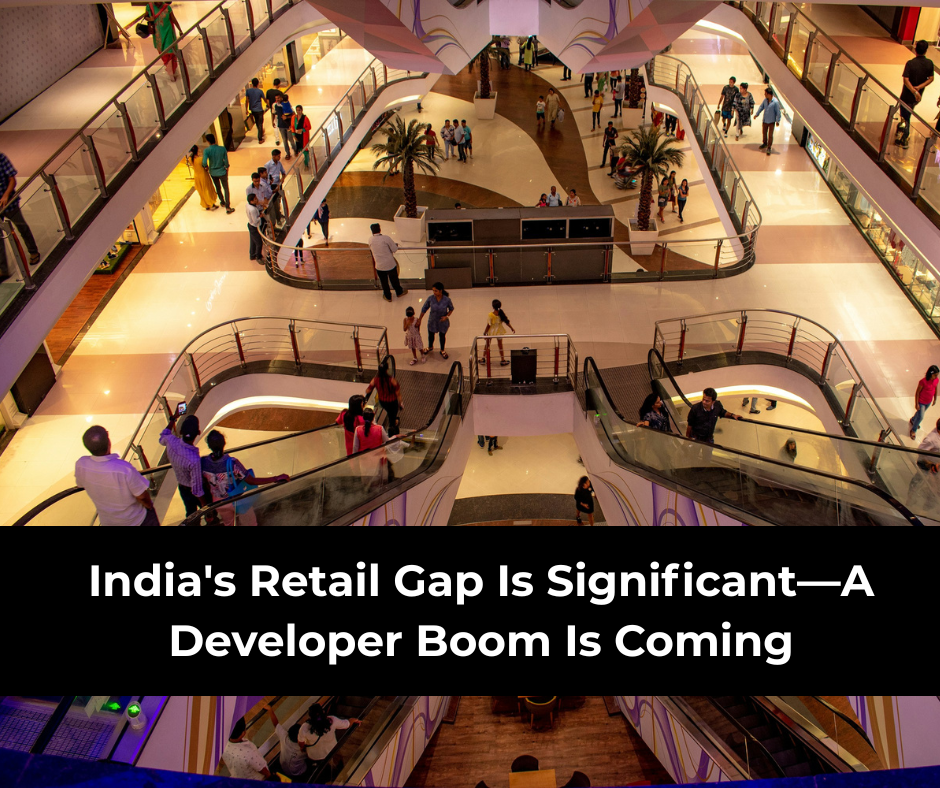
Here’s the retail paradox: India is one of the world’s fastest-growing economies, but there’s approximately only one Grade-A mall for every 1.9 million people.
That’s surprisingly low for a country with a growing middle class and rising appetite for modern retail experiences.
Across 1.4 billion people, only ~ exist—most clustered in major cities. As shopping habits evolve, it’s clear: India needs more modern retail spaces to keep up.
Let me walk you through why I think India's mall situation is about to change.
India's Mall Market Today: Quick Summary
India’s mall market is in the early stages of rapid growth, with demand outpacing supply in key cities. Here’s a snapshot of where things stand today:
Current Market Size
India's top cities currently have about of Grade-A mall space. This equates to roughly 0.5 square feet of mall space per person, which is very low compared to developed countries.
India has just 1,000 malls for 1.4 billion people—and most are packed into a few big cities like Delhi, Mumbai, Bengaluru, Kolkata, Hyderabad, Chennai, Pune, and Ahmedabad.
Growing Demand vs. Supply
The supply of mall space is increasing, but demand is growing even faster. In 2024 alone, over of retail space was leased, which outpaced the amount of new space becoming available.
Vacancy Rates Declining
Vacancy rates in malls have dropped significantly from 15.5% in 2021 to just 9% in 2023. This sharp decline signals a strong appetite from retailers and a competitive market for prime locations.
Mall Density: How India Compares to Developed Economies
India’s organized retail space is pretty small compared to developed countries. At just 0.5 square feet of retail space per capita, India lags far behind developed markets.
In comparison, the United States has of retail space per person—roughly 45 times more than India. Even Canada and Australia, with their smaller populations, are ahead.
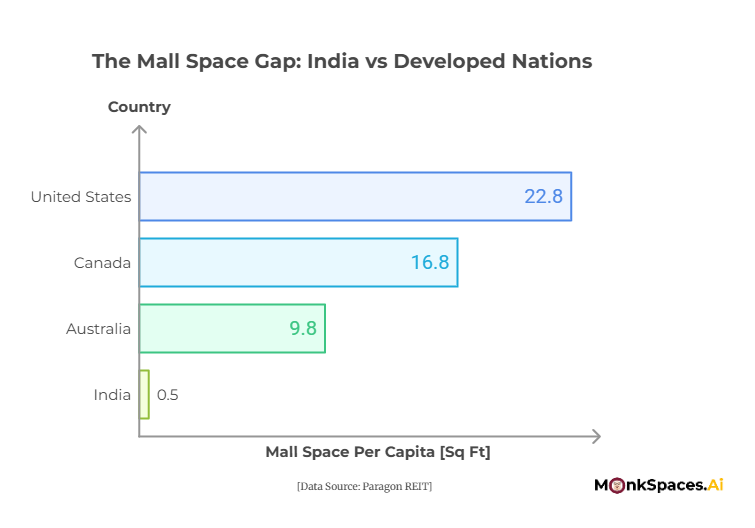
While India has significantly less mall space per capita than other developed countries, it also means there’s massive room for growth in the organized retail sector.
Mall Density: How India Compares to Developing Countries
Compared to other developing countries, India still falls behind.
For instance, by 2025, Thailand is expected to have square feet of mall space per capita. Turkey's mall space stood at square feet per capita in 2023. South Africa has around square feet per capita.
These are broad estimates based on the available data but it gives you an idea of the bigger picture - there is a big contrast. India has just 0.5 square feet of retail space per capita.
This highlights a significant gap in India's retail infrastructure compared to its peers.
Industry reports also suggest that India's retail sector hasn't kept up with other developing markets like Indonesia and Vietnam, although the latest figures for these countries are not available.
The contrast makes one thing clear: India has plenty of room to grow.
Huge Growth Ahead
Right now, there’s a significant gap in mall space compared to both developed countries and other developing economies.
But here's the good news: we're headed upwards.
With a growing middle class, rising disposable incomes, and shifting consumer preferences, India’s retail landscape is primed for rapid expansion.
The demand for modern retail spaces is only going to increase, and developers have a huge opportunity to capitalize on this wave.
Ride India’s Retail Wave with MonkSpaces.Ai
If you're a mall developer looking to capitalize on India's retail boom, MonkSpaces.Ai is the smart solution you need.
With everything from mall management and leasing to operations and shopper experience—all powered by one platform. Let us make it easier for you to tap into the massive growth potential in India’s retail market.
Explore More

See what happens
when AI runs execution.
If your teams are stretched by noise, the problem is not intent. It is execution at scale. Let's fix it today.