The Coworking IPO Rush: What’s Fueling India’s Flex-Space Growth?
Ajay Kumar
The past year has been a turning point for the coworking sector. Growth has been steady, but the bigger story is that more operators are going public.
In just 14 months, we’ve seen a rapid-fire lineup of listings:
- and were both subscribed over 12x times in July’25
- Awfis Space Solutions IPO, listed in 2024, was subscribed
- WeWork India has received SEBI approval and is set to go live soon.
There’s more to this coworking IPO trend than being just a hot streak.
Capital markets are backing what was once considered a fringe model, turning coworking into a category with institutional confidence and long-term upside.
Key Growth Drivers
- RTO mandates are reshaping workspace needs
- Enterprise demand is powering flex space adoption
- GCCs are fueling a major share of office absorption
- Tier-2 and tier-3 cities are driving new expansion
What’s Fueling the Next Chapter of Coworking Growth?
The story of coworking growth starts with something bigger: structural and behavioral shifts in the market.
Here’s a closer look at what’s driving this growth wave:
1. RTO mandates are back
India’s largest employers are pulling employees back with RTO mandates, but not all are expanding leased campuses.
Instead, they’re moving to managed offices and flexible workspaces. This lets them scale up or down, city by city, without locking capital into real estate.

For example, last month, ICICI Bank inked an with WeWork India to house their IT, tech, and support teams.
So, coworking is now Plan A for many HR and admin teams.
2. Enterprises are adapting to the coworking model
Coworking is no longer associated solely with startups or freelancers. Today, it serves the country’s largest employers.
According to Awfis, enterprise clients now represent of demand.
Companies like Microsoft, IBM, and Amazon have leased coworking spaces to support distributed teams, innovation units, and regional operations.
This shows coworking has crossed a key threshold: it now supports scale, not just speed. As needs evolve, coworking is meeting them with speed and professionalism.
3. GCCs want flexible workspaces
Global Capability Centres (GCCs) are expanding rapidly and redefining the commercial real estate landscape in the process.
In 2025, they’re expected to account for of total office demand in India. In fact, was leased by GCCs alone in Pune in the first half of 2025.
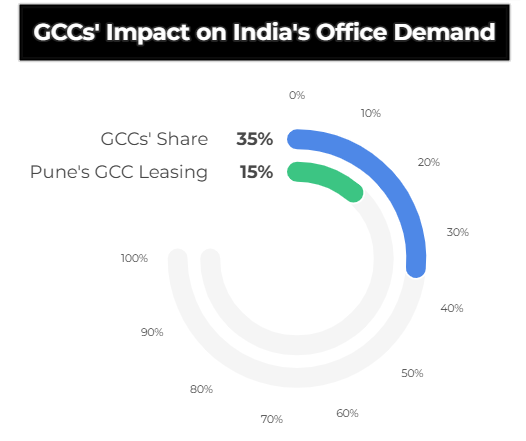
This aligns perfectly with what flexible workspace operators offer. GCCs now view coworking as a critical part of their growth strategy.
4. Tier-2 and Tier-3 cities offer strategic advantages
What’s interesting is that Tier-2 and Tier-3 cities are becoming breakout players in the coworking expansion story.
As GCCs decentralize and hybrid models gain traction, new demand centers are emerging beyond the traditional metros.
Add to that a major shift in the startup landscape: by 2030, of new startups are projected to come from Tier-2 and Tier-3 cities.
Look at the leasing in , for example:
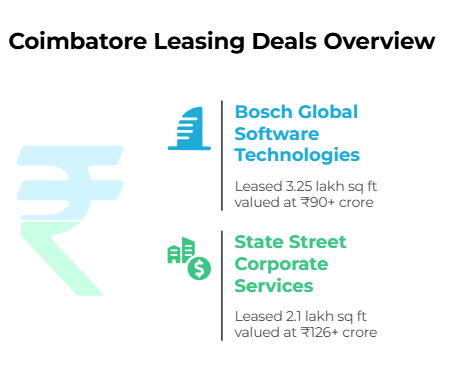
The message is clear: the future of workspace growth is distributed, agile, and already underway.
Understanding Gaps & Opportunities
While the overall growth trajectory is strong, most coworking operators are focused on enterprise clients.
In doing so, they’ve left behind a fast-growing segment: small businesses and early-stage teams.
These users prioritize flexibility, affordability, and a strong sense of community. Operators who build specifically for their needs, with clear intent and purpose, are well-positioned to lead the next phase of coworking growth.
Want to Lead the Next Phase of Coworking Growth?
Focus on efficiency and scale without the complexity.
The Hive, GoSpaze, and Buzzworks use MonkSpaces.Ai to streamline operations and expand faster across cities.
Explore More



See what happens
when AI runs execution.
If your teams are stretched by noise, the problem is not intent. It is execution at scale. Let's fix it today.